I remember once writing that Buck Rogers was the first RPG set in sci-fi rather than medieval fantasy. I was wrong. Legacy of the Ancients proved it to me quietly and without fanfare — this title from Quest Software came out in 1987, and Buck Rogers didn't arrive until a year later. Mistake acknowledged, moving on.
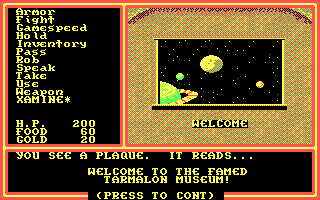
Legacy of the Ancients is a classic western RPG in the direct line of Ultima tradition, except with one striking difference — its world isn't medieval fantasy, but a flourishing civilization with a technological edge, artifacts left behind by ancient peoples, and an atmosphere that leans more toward adventure science fantasy than Tolkien. The player explores a vast world, collects items, wages turn-based combat, and tries to unravel the mystery of the ancient legacy the game takes its name from.
Mechanically, it's a solid, if unremarkable work of its time. Movement through the world happens from a bird's-eye perspective, combat is simple and straightforward, inventory and character management are intuitive even without a manual — that was a bonus in 1987, not a given. An interesting idea is the minigames and side activities woven directly into the game world, which breaks up the monotony of exploration somewhat. There aren't many of them and they probably wouldn't captivate anyone today, but back then it was a nice way to keep players glued to the screen.

The game has aged decently, if quietly. There's nothing here iconic enough to land it on a list of essential retro experiences today, but nothing offensively bad either. Rather, it's a solid representative of the genre that did the right things but didn't leave a lasting mark. At a time when RPGs on computers were still finding their footing and every other one was a Ultima knockoff, this was a step slightly to the side — and that deserves credit.
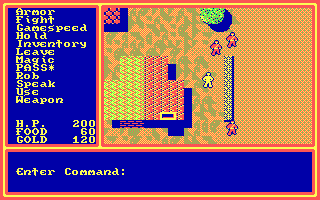
Today it fits best those who love slow exploration, aren't afraid of simple graphics, and want to see what the genre looked like before Baldur's Gate and company arrived. You can fire it up in the browser via DOSBox Online without a hitch, and an hour with it is time better spent than reading my older article about Buck Rogers.
 old
old


 ▶Dungeon Master1989MS-DOS / PC


 ▶Light Crusader1995Sega Mega Drive
 ▶Doraemon: Giga Zombie no Gyakushuu1990Nintendo NES
 ▶Space Rogue1989MS-DOS / PC
