Winter 1992, a Hercules monitor glowing in the darkness, and I'm trying to figure out why a German heavy cruiser just sank my entire squadron before I could even issue an order. Great Naval Battles: North Atlantic 1939–1943 from SSI was not a game for the impatient.
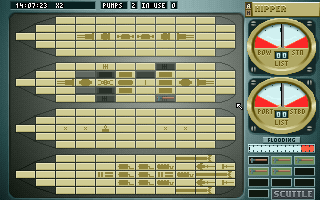
SSI knew how to make serious simulations back then — these weren't arcade shooter people, but strategy veterans with thick manuals. Great Naval Battles placed players in the convoy battles of the North Atlantic, where the British Royal Navy and German Kriegsmarine fought a series of bloody clashes for control of supply routes. No Pacific adventures, no famous bays — just grey waters, fog, oil, and torpedoes.
The game operated on multiple levels simultaneously. At the strategic level, you issued orders to entire task forces — where to sail, how to form the squadron, when to attack. At the tactical level, you could zoom in to a specific ship, control its turrets, and aim and fire yourself. The transition between both levels was unusual for its time and quite functional. And since few have the time to personally command every ship in every battle, much of the repetitive work could be delegated to the AI — which was a pretty civilized approach back then. Controls were keyboard-based, the interface dense with icons and numbers, and the manual read like mandatory preparation, not optional reading.

What looks archaic today? Pace. The game takes its time, refuses to rush, and definitely doesn't hold your hand. Even for 1992, the graphics were functional rather than flashy — VGA palette, but economized with an admiral's strictness before battle. The Sound Blaster sounds did what they could. Yet the game had something many later titles lost: weight. Every ship costs something, every formation mistake hurts, every torpedo hits because you know it can't be undone.

Today, Great Naval Battles is best enjoyed by those unafraid to read the documentation and who don't need results in five minutes. If you're fascinated by World War II at sea and want more than just clicking icons, this title shows how SSI took simulation seriously — something that was lost long before the studio even disappeared. It does not run in the browser here — the page carries a description, screenshots and the release data. Just download the manual first. Without it, you'll find yourself in the middle of the Atlantic without a compass.
 old
old


 ▶Free Croatia (DOS game)MS-DOS / PC
 ▶Pinball Fantasies1992MS-DOS / PC


