Year 1987, EGA card, five and a quarter inch floppy disk, and a name that sounds like the owner of a local garden center. Castle Ralf grabbed my hand back then and refused to let go — not because it was brilliant, but because I simply couldn't come to terms with the fact that some computer was getting on my nerves more than my older brother.

Douglas Associates released a text adventure set in a castle whose master — one Dr. Bellefleur Q. Izgotcha III — is a full-time puzzle designer and part-time host. The plot is simple: you get inside, the drawbridge closes behind you into the moat, and you search for a way out. The castle is his laboratory, his playground, his collection of traps. You are the exhibit.
The game runs on a classic text parser — you type commands, the game responds, occasionally killing you or just sending you back to the start without warning. The atmosphere is slightly absurd: somewhere an acrobatic hamster is moving around, elsewhere imprisoned alligators are sitting and plenty of other oddities that have no business in a normal castle. The puzzles are designed with that specific cruelty that was considered good design in the eighties. Logic exists here, but sometimes you have to search for it with a flashlight.
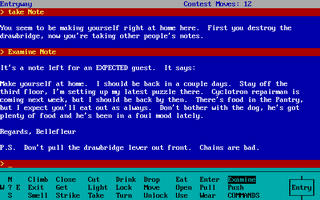
What sets Castle Ralf apart from a heap of similar shareware titles is precisely that tone — it doesn't try to be epic or scary, it's deliberately bizarre and a bit self-ironic. A castle as the workshop of an eccentric inventor was a fresh idea back then. Today the game has aged the way text adventures without context hints age: hard and without mercy. Dead ends without warning, a parser that doesn't understand half of what you type, and no automap. Anyone who didn't grow up with this will tend to close the window within ten minutes.
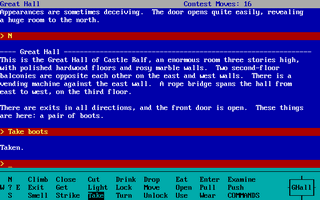
Today Castle Ralf suits those who have a sentimental relationship with text adventures and don't mind that the game uncompromisingly assumes patience, pen and paper notes, and a willingness to try the same thing thirty times differently. In a browser, via DOSBox emulation, at least you don't have to hunt for it at a flea market. Playing it today mainly means understanding what that era was like — and admitting that the hamster in the castle is still a better boss than a lot of stuff from later years.
 old
old


 ▶Amazing Spider-Man1989MS-DOS / PC


 ▶The Farmer's Daughter2002MS-DOS / PC