Sometime in 1991, I borrowed a floppy disk from a classmate that had "bush buk" scrawled on it in marker — and that was enough for me back then. PC Globe was mainly known as a maker of encyclopedic atlases on CD, so when they decided to make a game, nobody really knew what to expect.

Bush Buck: Global Treasure Hunter is something that looks like an educational game but tries to quietly work as entertainment too. You travel around the world, hunting for lost objects scattered across various corners of the globe, and you have to transport them back to your base. The geographical theme is clear — this was the era when Carmen Sandiego ruled school computer labs and every publisher wanted to stake a claim to a similar genre.
Gameplay is simple to the bone. You pick a difficulty level, which mainly changes external conditions like weather and various misfortunes, but the core game loop stays pretty much the same regardless of your settings. Two players can compete against each other or against the computer, which was pretty standard for family gaming back then. Controls aren't a problem even today, because there's not much to control.
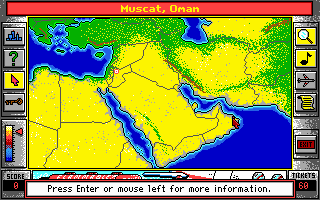
The issue is that Bush Buck was never particularly deep. You can feel the encyclopedic foundation from PC Globe — there are geographical facts, there are locations — but the game mechanics around it are thin. Carmen Sandiego worked with mysteries and deduction; here it's more a question of whether luck shows up before your opponent. It aged as you'd expect from a title that was half educational software and half family-game-night material.

Today Bush Buck will mainly appeal to nostalgics who remember DOS titles from an era when educational software still believed geography could be sold as adventure. For an afternoon in an emulator, it's fine archaeology — you'll see what made up the gaming landscape of 1991. Don't expect more than that and you won't be disappointed.
 old
old
 ▶Prehistorik 21993MS-DOS / PC


 ▶Contra1988MS-DOS / PC

 ▶Commander Keen 4: Secret of the Oracle1991MS-DOS / PC
 ▶Dangerous Dave in the Haunted Mansion1991MS-DOS / PC


 ▶Toy Story1995Sega Mega Drive


