I played Battleship on paper at school during math class. My teacher thought I was solving equations. I was calculating coordinates where the enemy cruiser might be.
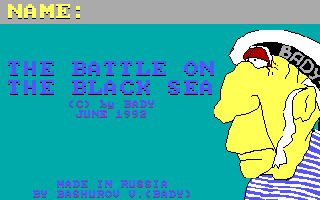
The Battle on the Black Sea from 1992 is the computer version of the same game — ships, grid, you shoot blind and hope. The author, nicknamed Bady, released it for MS-DOS, and it's no surprise that it's extremely lightweight software. No big studio behind it, no team of artists. It's one person, simple code, and an idea that existed long before computers.
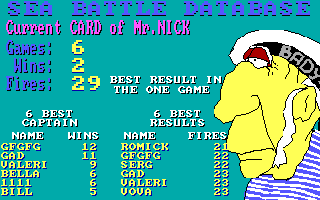
The mechanics are faithful to the original: you place your ships, you take turns guessing coordinates, whoever sinks the entire fleet first wins. The game remembers your name and keeps some statistics, which in 1992 felt like a welcome bonus — at least you had the feeling your victory meant something. The controls are straightforward, the computer plays like a computer of that era: without deeper tactics, mostly randomly, sometimes frustratingly lucky.
What's unusual about this particular version — and I'll admit I expected this least of all — is the setting. You play as Russia against Ukraine. On the Black Sea. The game came out in 1992, shortly after the Soviet Union's collapse, when the relations between these two new states were still being formed. It's hard to say what the author intended by this, if anything at all. Today, naturally, it reads differently. The choice of opponent feels like at least an interesting historical document of a time when nobody could imagine what would become of it all.

As a game itself, it doesn't offer much. Battleship was always more of an exercise in patience than in strategy, and this version couldn't squeeze more out of it than the genre allows. The graphics are text-based or very simple, the sound probably nonexistent or symbolic. It's a school desk notebook converted to DOS — nothing more, nothing less. Today it's played more by those who collect shareware curiosities or want to see what software looked like from the era when individuals made it simply because they enjoyed it. And then there's that geopolitical spice that turns an ordinary game of ships into a small, somewhat chilling historical document.
 old
old


 ▶Big Business1990MS-DOS / PC
 ▶Warlords1990MS-DOS / PC


 ▶Chess1998Sega Mega Drive


 ▶Battle Bugs1994MS-DOS / PC


