Three buttons. Three enemies. One woman in trouble on a street somewhere in early post-Soviet software reality. That is the entire premise of Choose an Enemy, a 1991 DOS brawler from Russian Soft, and honestly, it respects your time in a way most games of that era forgot to.
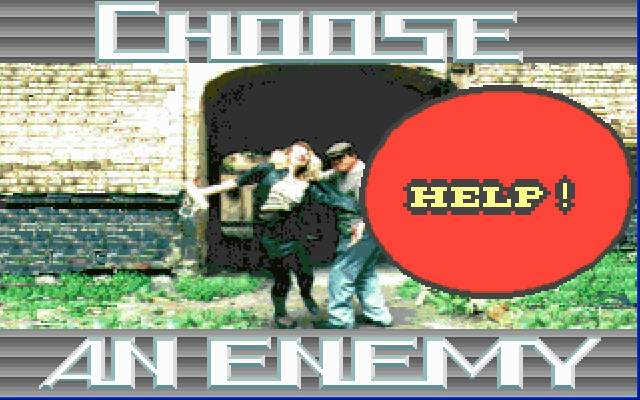
You step in to stop a mugging. The game gives you a choice of opponents — each one presumably different in difficulty or fighting style — and then you get to work. No cutscenes, no manual you had to read on the bus home, no lore. Just a guy, a threat, and whatever passed for a punch animation on a 386 in 1991.
The mechanics are exactly what you would expect from a one-man or two-man Eastern European outfit cutting their teeth on PC game development at the precise moment the Iron Curtain stopped being a thing. The controls are functional rather than elegant, the hitboxes are approximate in the way that made you argue with your friend about whether that punch actually landed, and the whole thing runs at a pace that today would be called "deliberate" and in 1991 was called "this is what we had." It is a street brawler in the most stripped-down sense — closer to a tech demo with ambition than a polished arcade port.

What makes Choose an Enemy worth remembering is not the gameplay, which is thin. It is the artifact itself. Russian Soft releasing a DOS action game in 1991 is a data point in the history of PC gaming that most people in Western Europe and North America simply missed. While we were playing Duke Nukem or struggling through Wolfenstein prototypes, there was an entire parallel universe of Eastern Bloc developers figuring out the same hardware with different resources, different reference points, and a different relationship to what a game was supposed to be. This is a small, rough piece of that universe.

It has not aged into a hidden gem. The honesty requires saying that clearly. The combat loop gives you very little to hold onto once the novelty of its origins wears off, and even by 1991 standards there were more generous examples of the genre available. But it runs in the browser in about thirty seconds, and for anyone with an interest in where PC gaming actually came from — not just the Western canon — spending fifteen minutes with it is worth the curiosity. Think of it less as a game to beat and more as a transmission from a moment when software was just starting to cross borders that politics had only just opened.
 old
old


 ▶Doom1993MS-DOS / PC


 ▶Contra1988MS-DOS / PC


