June 1944, Utah Beach. I remember sitting in front of a monitor as a raster image of the beach landing slowly loaded, thinking to myself that this was a different league altogether from Dune II. No bases, no resource gathering — just maps, high command, and the bloody arithmetic of war strategy.
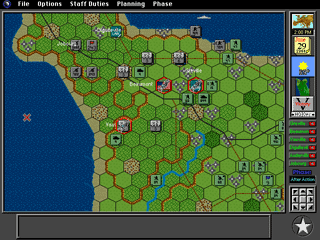
V for Victory from Atomic Games came out in 1991 and quickly built a reputation on the DOS scene as a serious wargame for adults. The base game brought a scenario dedicated to the Normandy landings — specifically the Utah Beach sector — and over the following years, additional packages covering various World War II battlefields were added. Today you can download a complete package with all four scenarios at once, which is significantly more convenient than the original fragmented distribution.
The game is turn-based and holds firmly to the tradition of tabletop wargames, and it's not ashamed of it. You operate with infantry regiments, tank units, and artillery on a hexagonal map, where terrain, supply lines, and troop morale play just as important a role as sheer numerical superiority. Mouse control on DOS worked, but the interface has that wrinkled honesty of an older era — information is available, just not always where you'd expect to find it on your first try.

Atomic Games knew what they were doing. The simulation doesn't fight with the player, but with the genuine complexity of operational command. Logistics, choice of attack sequence, maintaining lines — this game doesn't simplify to flatter you. It aged predictably: the graphics are functional and nothing more, the MIDI soundtrack deserves only the verdict of "period standard." What hasn't aged badly is the core design. The mechanics hold together and decisions carry weight.
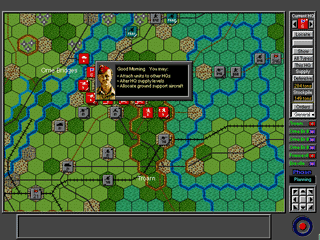
Today V for Victory appeals to a specific type of player: one who loves World War II history and doesn't want to experience it through killstreaks and regenerating health, but through shifting front lines and weekly supply rhythms. In a browser it's a comfortable way to try out a genre that enjoyed significantly more attention on PC in the nineties than it does today. If you want to get a sense of what turn-based war strategy looked like before RTSes pushed it aside — here's your answer.
 old
old


 ▶Ancient Art of War1984MS-DOS / PC

 ▶Battle Bugs1994MS-DOS / PC


 ▶Boppin1994MS-DOS / PC


