Sometime in the first half of the nineties, a kid sat in front of a monitor expecting math homework and instead got hit with a bouncy platformer full of numbers. And he discovered he enjoyed it. Treasure MathStorm from The Learning Company, released in 1992, was exactly that kind of sneaky trap — educational software that wouldn't brag about itself.
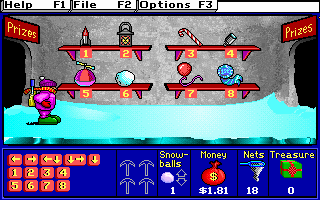
It belongs to the Super Solvers series, where you face off against the villain Master of Mischief. This time, the guy lost his marbles after losing, grabbed a weather machine, and buried the entire mountain in snow. He froze the throne, scattered the treasures, and generally caused chaos. Your job is to logically clean it up — collect, count, solve. The fairy-tale winter mountain setting worked well: visually it was cohesive and readably clear for a kid.
Mechanically, it's a mix of platforming movement across screens and mini-games focused on basic math — addition, subtraction, counting money, telling time. You collect items, complete elf quests, open chests. Difficulty was adjustable, so theoretically the game grew with the player. In practice, most kids probably found their ceiling pretty quickly and stayed there, because nobody wanted to admit they'd lower the level. That's exactly the psychology this educational series was built on.

What set Treasure MathStorm apart from so many badly made educational titles back then was the pacing. It didn't wait for you. The platform moved, enemies walked, time ran. The educational content was woven into the gameplay, not slapped on top of it as an afterthought. Graphically it was solid EGA/VGA stuff for its day, and the PC speaker or Sound Blaster music served its purpose — unforgettable it wasn't, but it didn't get in the way. Today it all looks fragile and pixelated, but the readability held up surprisingly well.
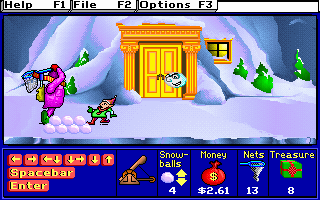
Today Treasure MathStorm appeals mostly to parents looking for something for kids aged six to ten who don't want just passive consumption. There's a reward loop, there's movement, there's a reason to do the math right. For nostalgia fans who remember the Super Solvers series, it's a pleasant return — short, but honest. Firing it up today in DOSBox or straight in the browser through archive emulation is no hassle, and you can beat the whole game in an afternoon. Some things just don't need to be long.
 old
old


![The Colonel's Bequest (French) [FanTrad]](/media/retro/box/1033664.png.webp)


 ▶Amazing Spider-Man1989MS-DOS / PC


