I remember back in 1991 looking at the SimEarth box and thinking: this has to be SimCity, just bigger. I was close to the truth, but at the same time I had absolutely no idea what I was getting into.

SimEarth from 1990 by Maxis — the people who released SimCity the year before — is a planetary simulator in the most literal sense. You don't play as a mayor or a military commander. You play as a planet. Or rather, as some kind of god who sets atmospheric parameters, watches life evolve from the first cells to civilization, and hopes it all doesn't collapse before you manage to do anything interesting. The foundation is James Lovelock's Gaia hypothesis — the idea that a planet functions as a single living organism. Maxis took it seriously and built an entire game around it.
Control is through menus and icons, as was customary back then, but the number of variables that SimEarth tracks is striking for 1990. Temperature, atmospheric composition, the ratio of land to oceans, the evolution of different species — it all influences and changes each other. The problem is that you wait a very long time for the results of your work. The simulation runs in geological time, so before simple organisms evolve into something resembling civilization, a lot of real minutes pass at the screen where not much moves. The game lacks what's called today "game feel" — immediate feedback that would keep you at the monitor. The manual had over a hundred pages and without it you were basically lost. Not metaphorically — literally you had no idea what you were doing and why.

And yet I remember SimEarth fondly, even though as a twelve-year-old I never really understood it properly. It was one of the first attempts to bring real science into a game — not as decoration, but as the foundation of the mechanics. Today it looks like educational software with a gaming shell. Back then it was something I saw at a friend's house and thought that maybe computers could simulate absolutely everything. It ages heavily: the graphics are functional but dull, and the pacing would discourage most players today before they could properly understand the rules.
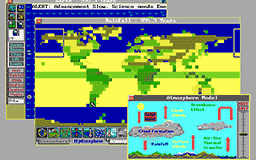
Today SimEarth suits a narrow group — people who enjoy systems simulators for the sake of the system itself, not for rewards and challenges. If you enjoyed Dwarf Fortress or you're the type who reads the manual before launching a game, SimEarth might appeal to you as both a historical artifact and a working toy. You can easily play it in your browser through a DOSBox archive — just count on spending the first hour mostly reading the help. And that's not a criticism. It's both a warning and an invitation at the same time.
 old
old


 ▶Pinball Fantasies1992MS-DOS / PC


